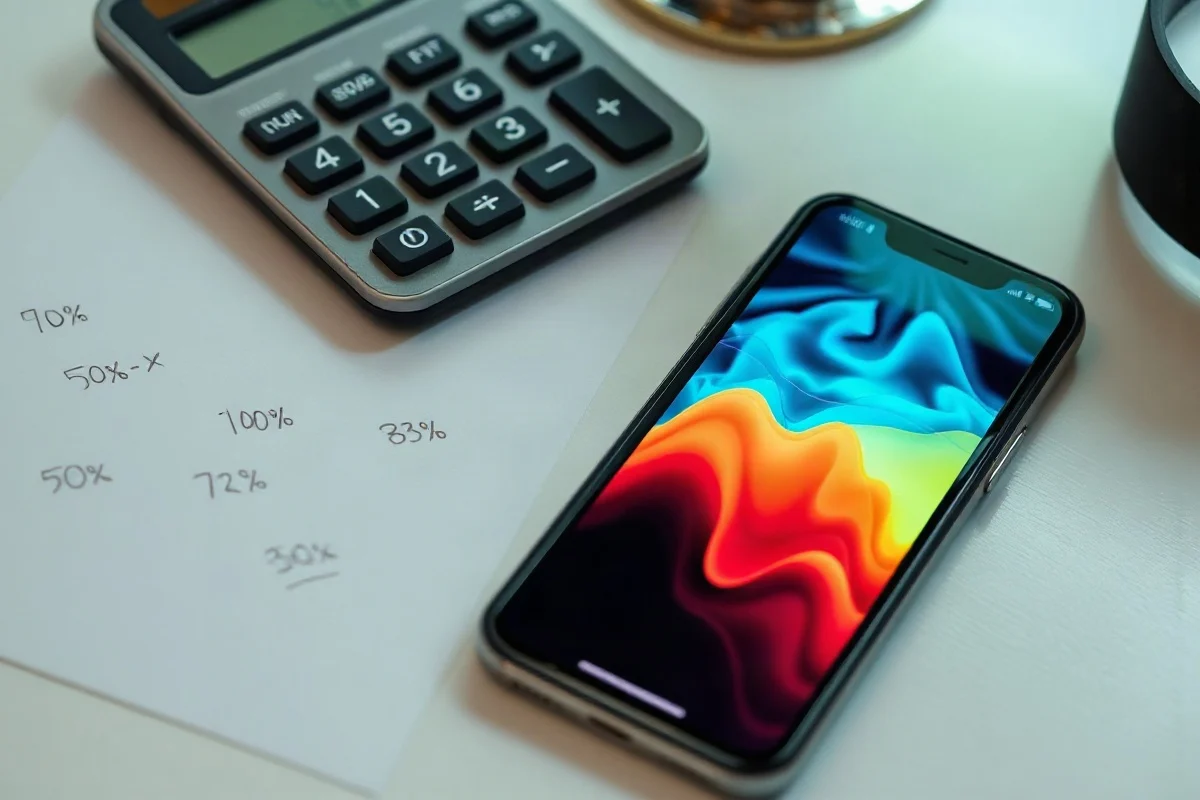
A 50% loss requires a 100% gain to recover to the original value. If an investment falls from $100 to $50, a 50% increase takes it only back to $75. To reach $100 again, the remaining $50 must double. This is the central idea behind loss recovery: percentage changes apply to the current value, not the original purchase price.
The same arithmetic applies to cryptocurrencies, stocks, funds, and other volatile assets. Understanding it can help you interpret portfolio performance, evaluate drawdowns, and use a Crypto Profit Calculator more accurately. The calculation is educational, not a prediction of what any asset will do next.
The basic loss-recovery formula
Assume you begin with an amount called the initial value. After a decline, the remaining value is lower, so the required recovery percentage must be measured against that smaller amount.
Use this formula:
Required recovery percentage = (Initial value − Current value) ÷ Current value × 100
If the loss is expressed as a decimal, an equivalent formula is:
Required recovery percentage = 1 ÷ (1 − loss percentage) − 1
For a 50% loss:

1 ÷ (1 − 0.50) − 1 = 1
Converted to a percentage, 1 equals a 100% required gain. In other words, the asset must double from its post-loss value.
A simple dollar example
Suppose you buy an asset for $1,000. A 50% decline reduces the position to $500:
$1,000 × (1 − 0.50) = $500
To recover, the position needs to increase by $500. Compared with the current $500 value, that is a 100% gain:
($1,000 − $500) ÷ $500 × 100 = 100%
A 50% gain on the remaining $500 would add only $250, producing a value of $750. That would still leave the position 25% below the starting amount, before considering trading fees, spreads, taxes, or other costs that may apply.
Why the percentages are not symmetrical
Percentages use a reference point, or base. Before the loss, the base is $1,000. After the loss, the base is $500. Because the base has changed, an equal percentage move in the opposite direction does not produce an equal dollar result.
Here is the sequence:
- A 50% loss from $1,000 removes $500.
- The remaining balance is $500.
- A 50% gain on $500 adds $250.
- The final value is $750, not $1,000.
The reverse is also important. A 100% gain from $500 adds another $500, bringing the position back to $1,000. The gain is larger in percentage terms because it is calculated from the reduced balance.
Loss-recovery percentages by drawdown
The deeper the loss, the larger the required recovery. The following examples use simple percentage math and assume no additional deposits, fees, taxes, staking rewards, dividends, or other changes in value.
| Loss | Value remaining | Gain needed to recover |
|---|---|---|
| 10% | 90% of the original value | 11.11% |
| 20% | 80% | 25% |
| 30% | 70% | 42.86% |
| 40% | 60% | 66.67% |
| 50% | 50% | 100% |
| 60% | 40% | 150% |
| 70% | 30% | 233.33% |
| 80% | 20% | 400% |
| 90% | 10% | 900% |
For example, after an 80% loss, only 20% of the original value remains. Returning to the starting value requires that remaining amount to increase fivefold, which is a 400% gain. These figures describe the arithmetic only; they do not indicate that a recovery is likely or that a particular asset will return to a former price.
How this applies to cryptocurrency portfolios
Crypto markets can experience large price swings, and individual altcoins may behave differently from broad market benchmarks. A token can lose value because of changing market conditions, reduced liquidity, project-specific developments, dilution, security incidents, competition, or other factors. Some assets may recover partially, recover after a long period, or fail to return to a previous price. Past price levels do not create an obligation for the market to revisit them.
Portfolio math can also differ from single-asset math. If one holding falls 50% while other holdings remain stable, the total portfolio loss will be less than 50%, depending on position sizes. Conversely, correlated declines can cause several holdings to fall at the same time.
To calculate a portfolio drawdown, compare the portfolio’s current value with its previous value:
Portfolio loss percentage = (Previous value − Current value) ÷ Previous value × 100
Then calculate the recovery requirement using the current portfolio value as the base. Do not calculate recovery from the original amount alone, because that would understate the percentage move required.
Example with different position sizes
Imagine a portfolio worth $2,000, split between two assets:
- $1,500 in Asset A, which declines by 50% to $750.
- $500 in Asset B, which remains at $500.
The portfolio falls from $2,000 to $1,250, a loss of $750. The portfolio drawdown is:
($2,000 − $1,250) ÷ $2,000 × 100 = 37.5%
Recovering from $1,250 to $2,000 requires a gain of $750. Relative to the current value, that is:
($2,000 − $1,250) ÷ $1,250 × 100 = 60%
This example shows why position size matters. The asset lost 50%, but the portfolio lost 37.5% because the second position did not decline. The required portfolio recovery is therefore 60%, not 100%.
Compounding can magnify both losses and gains
When an asset moves through multiple periods, each percentage change is applied to the latest value. The changes should be compounded rather than simply added together.
If an asset falls 20% and then rises 20%, the result is not a return to the starting point:
Starting value × 0.80 × 1.20 = starting value × 0.96
The final value is 96% of the starting value, representing a 4% net loss. A later 20% gain is calculated from the reduced value after the decline, not from the original value.
The same principle applies to a series of crypto price movements. A calculator can help you model sequential gains and losses, but the result depends on the inputs. Current prices, trading fees, spreads, staking income, deposits, withdrawals, and taxes can change the outcome and should be checked separately using current, reliable information.
Fees and other real-world considerations
The simple recovery formula assumes that every dollar of market movement reaches your position. In practice, transaction costs can make the required recovery slightly higher. Depending on the platform and transaction, relevant costs may include trading fees, network fees, withdrawal charges, bid-ask spreads, slippage, and conversion costs. These details are time-sensitive and can vary by service, asset, location, and transaction type.
For a more complete estimate, start with the current position value, subtract expected selling or conversion costs, and compare the net amount with the original value. Avoid entering assumed fees as facts unless you have verified them from the applicable platform or network source. Our Crypto Fee Calculator can help organize fee assumptions, but its output is only as accurate as the data entered.
Taxes may also affect the amount you keep after a sale or exchange. Tax treatment is jurisdiction-specific and can change. This article does not provide tax advice. Consult current guidance from the relevant tax authority or a qualified professional before making decisions based on tax calculations.
Using the calculation without turning it into a prediction
The recovery percentage tells you what mathematical price increase would be necessary if the position eventually returned to its starting value. It does not forecast timing, probability, liquidity, project quality, or future market demand.
For example, if a token falls from $2 to $1, the token needs a 100% increase to reach $2 again. That statement is arithmetic. It does not mean the token is undervalued, that a recovery is due, or that buying more is appropriate. Decisions about holding, selling, or adding to a position require separate analysis of risk, liquidity, objectives, time horizon, and the asset’s underlying circumstances.
When reviewing a loss, consider documenting:
- The original amount invested and the actual entry price.
- The current position value and the source of the current price.
- Fees, spreads, and other transaction assumptions.
- Whether the calculation covers one asset or the entire portfolio.
- Any deposits, withdrawals, staking rewards, or transfers that affect performance.
- The largest acceptable loss and the conditions that would change your plan.
A practical workflow for checking a drawdown
1. Confirm the values
Use transaction records or account statements where possible. Crypto prices can differ across venues, and displayed prices may be delayed or based on different markets. Verify time-sensitive information with the exchange, wallet, protocol, or other primary source relevant to your transaction.
2. Separate price performance from cash flows
A deposit can increase account value without representing investment performance. A withdrawal can reduce account value without being a market loss. Keep contributions and withdrawals separate when measuring returns.
3. Calculate the drawdown
Subtract the current value from the previous or initial value, divide by the previous or initial value, and multiply by 100. Use consistent valuation times and currency units.
4. Calculate the recovery requirement
Divide the value that was lost by the current value. This gives the percentage gain required to return to the original level, before any additional costs.
5. Test alternative scenarios
Instead of assuming a recovery, model several possible price outcomes. A Crypto DCA Calculator may be useful for examining recurring purchases, but dollar-cost averaging does not remove market risk and does not guarantee a profit. Make sure any scenario clearly states its assumptions.
The key lesson
A loss changes the base used for the next calculation. That is why a 50% decline needs a 100% gain, a 75% decline needs a 300% gain, and deeper losses require increasingly larger recoveries. The formula is straightforward, but applying it responsibly means separating arithmetic from prediction.
Use the calculation to understand the size of a drawdown, check portfolio records, and compare hypothetical scenarios. Do not treat the required recovery percentage as evidence that an asset will recover. Cryptocurrency markets remain volatile, and prices, fees, market conditions, and applicable rules can change. Verify current information before acting, and consider professional advice for decisions that depend on your personal financial circumstances.
Comments
0No comments yet. Be the first to share a helpful note or question.
Leave a Comment
Your email address will not be published. Comments are reviewed before appearing on the site.