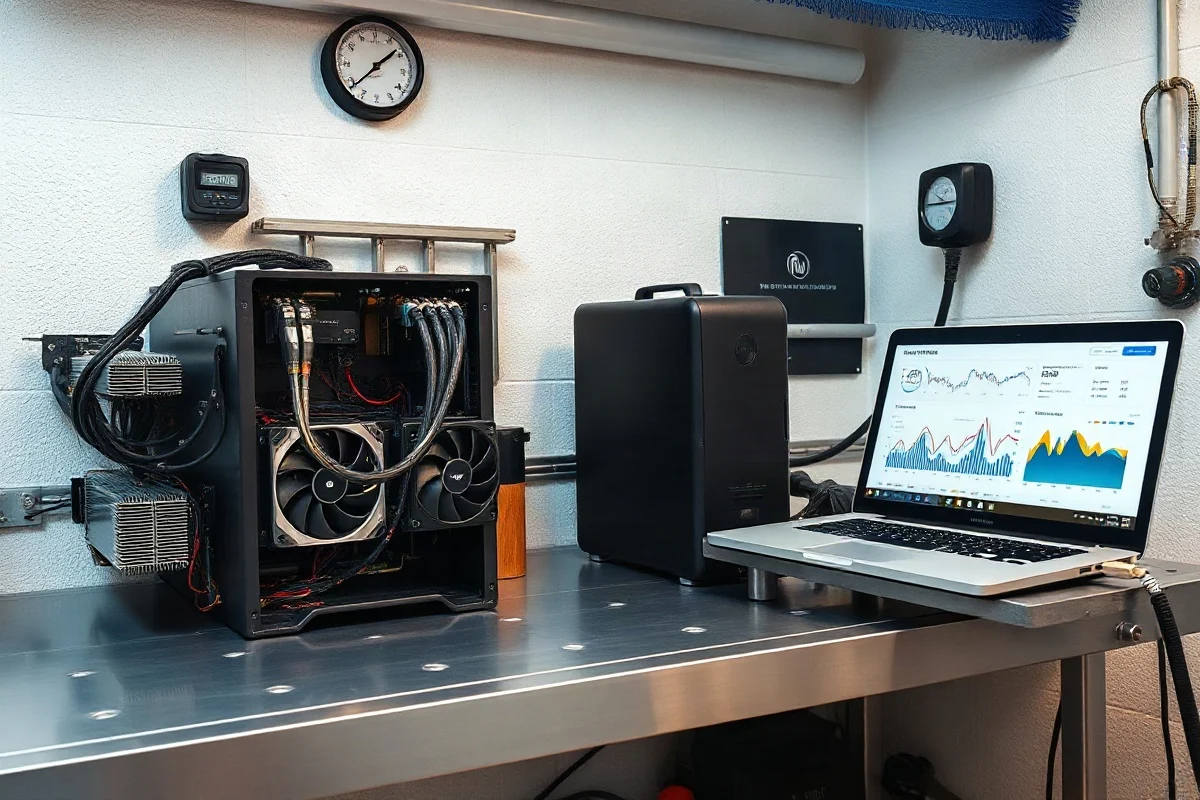
To calculate the ROI of a crypto mining rig, subtract all operating and ownership costs from mining revenue, then divide the resulting profit by your total investment. The basic formula is: ROI = (Total mining revenue − Total costs) ÷ Total investment × 100. A useful mining analysis must include the rig’s purchase price, electricity consumption, pool fees, maintenance, downtime, cooling, internet service, and any other relevant costs. Because coin prices, network difficulty, block rewards, and electricity rates can change, a projected ROI is an estimate rather than a guaranteed result.
What mining rig ROI measures
Return on investment measures how much value an investment has generated compared with the amount originally committed. For a mining rig, that comparison can be made over a specific period, such as one month, one year, or the rig’s useful operating life.
A positive ROI does not automatically mean that mining was financially attractive. You should also consider the time required to recover the initial investment, the risks of hardware failure, the opportunity cost of using your money for mining, and whether the equipment retains any resale value. A rig can show positive operating cash flow while still taking a long time to recover its purchase cost.
Mining ROI is also different from a simple coin-price return. A person who buys and holds a cryptocurrency is exposed mainly to the asset’s price movement, while a miner must manage equipment, energy consumption, network conditions, payout rules, and operational risks.
The core mining ROI formulas
Start by separating the calculation into revenue, operating costs, and initial investment.
Revenu brut du minage
Gross mining revenue = Coins mined × Realized coin price
The realized coin price should reflect the price at which you actually value or sell the mined asset. If you hold the coins instead of selling them, the calculation is based on an assumed or current market price and is not a completed cash return. Market prices are time-sensitive, so verify them using a current market data source before relying on the result.
Mining revenue may also be affected by network difficulty, hashrate, block rewards, transaction-fee conditions, pool performance, payout thresholds, and the specific algorithm supported by your hardware. These inputs can change, sometimes substantially.
Electricity cost
Electricity cost = Power consumption in kilowatts × Operating hours × Electricity rate
For continuous operation, a monthly estimate often uses the number of hours in the selected month. A more accurate calculation uses the actual operating hours and the rig’s measured power draw at the wall outlet.
For example, a rig drawing 1.2 kilowatts and running for 720 hours would consume:
1.2 kW × 720 hours = 864 kilowatt-hours
At an illustrative electricity rate of $0.12 per kilowatt-hour, the estimated electricity cost would be:
864 kWh × $0.12 = $103.68
This is an educational example, not a statement about a typical or current electricity rate. Check your utility bill, hosting agreement, or commercial power contract for the applicable rate. Some bills include demand charges, taxes, delivery charges, or tiered pricing that a basic kilowatt-hour calculation may not capture.
Net mining profit
Net mining profit = Gross mining revenue − Electricity cost − Other operating costs
Other operating costs can include mining pool fees, repairs, replacement fans, internet service, cooling, facility rent, hosting, monitoring equipment, insurance, and payment or withdrawal fees. If you account for depreciation, include it separately as a non-cash expense rather than accidentally subtracting the same hardware cost twice.
ROI percentage
ROI percentage = Net profit ÷ Total investment × 100
Total investment may include the mining hardware, power supply, frame, motherboard, storage, cables, network equipment, electrical work, ventilation, deposits, shipping, and setup costs. If you already own some of these items, decide whether you are calculating the incremental ROI of the new rig or the full economic ROI of the entire setup.
A hypothetical mining rig ROI example
Assume a hypothetical rig costs $3,000 to assemble, including hardware and setup. Suppose its estimated gross mining revenue is $240 per month. Assume electricity costs $120 per month, pool fees and routine maintenance total $20 per month, and the rig experiences no major repair during the example period.
The estimated monthly net profit would be:
$240 − $120 − $20 = $100
The simple monthly ROI on the initial $3,000 investment would be:
$100 ÷ $3,000 × 100 = 3.33%
A simple payback estimate would be:
$3,000 ÷ $100 = 30 months
This payback period is not a forecast. It assumes that revenue, electricity costs, uptime, network conditions, and maintenance remain unchanged, which is unlikely in a live mining environment. It also excludes taxes, financing costs, major repairs, resale value, and the changing value of mined coins.
If the rig stops operating for part of the month, the result changes. If mining revenue falls while electricity remains fixed, monthly profit can shrink quickly or become negative. This is why a range of scenarios is more useful than one optimistic estimate.
Costs to include before calculating ROI
Hardware and setup costs
Record the full delivered cost of the equipment. Depending on the rig type, this may include graphics cards or application-specific hardware, a motherboard, processor, memory, storage, power supplies, a frame, risers, cables, surge protection, and temperature sensors. Include shipping, sales taxes, import charges, and professional installation when applicable.
Electrical upgrades can be easy to overlook. A dedicated circuit, additional outlets, wiring, breakers, ventilation, or a suitable enclosure may be necessary. These expenses belong in the initial investment if they are required to operate the rig.
Recurring operating expenses
- Electricity and any demand-related charges
- Mining pool fees and payout fees
- Cooling, ventilation, or air-conditioning costs
- Internet and hosting charges
- Replacement fans, cables, power supplies, and other parts
- Monitoring, security, and facility costs
- Coûts de financement, si l’équipement a été acheté avec de l’argent emprunté
Pool fees and payout terms are time-sensitive. Review the pool’s current documentation and account statements instead of relying on an old estimate. For broader transaction-cost planning, you can also compare assumptions with the Calculateur de frais crypto.
Downtime and maintenance
A rig that runs continuously in a spreadsheet may not run continuously in practice. Internet outages, software errors, thermal throttling, scheduled maintenance, component failures, and pool interruptions reduce productive hours. Apply a realistic uptime assumption to projected revenue.
For example, if a model assumes 100% uptime but your planning assumption is 95%, multiply expected gross revenue by 0.95 before subtracting fixed costs. The correct adjustment depends on whether the outage also reduces electricity use. A powered-down rig may save energy, while a partially operational system may continue drawing power without producing expected revenue.
Use scenarios instead of a single ROI estimate
A practical model should include at least three cases:
- Optimistic case: favorable coin pricing, strong uptime, and stable operating costs.
- Base case: reasonable assumptions supported by current observations and conservative uptime.
- Stress case: weaker coin pricing, higher electricity costs, lower revenue, downtime, or an unexpected repair.
Do not treat these labels as probabilities unless you have a defensible method for estimating probabilities. They are simply different assumptions that show how sensitive the result is.
Break-even analysis is especially useful. Set net profit to zero and solve for the variable you want to test. For example:
Break-even gross revenue = Electricity cost + Other operating costs
If monthly gross revenue is below that level, the rig is losing money on an operating basis before recovering the hardware investment. You can also calculate a break-even electricity rate:
Break-even electricity rate = (Gross revenue − Other operating costs) ÷ Kilowatt-hours consumed
This rate helps you compare a mining plan with your actual utility cost or a hosting quote.
Mining difficulty, coin price, and network changes
Mining revenue is not fixed. More competition can change the amount of cryptocurrency earned by a given amount of hashrate. Network difficulty, total network hashrate, protocol rules, block rewards, and transaction-fee conditions may all affect results. Confirm current network parameters through an appropriate primary or official source when available, and treat calculator outputs as estimates.
Coin price creates another major source of uncertainty. A price increase can improve the value of mined coins, but a price decline can reduce revenue even if the number of coins mined remains similar. Selling immediately, holding the coins, or converting them periodically produces different financial outcomes and tax-record requirements. Do not assume that an unrealized price change is the same as cash profit.
When comparing mining with buying an asset, use consistent assumptions. A useful comparison may include the value of coins purchased with the same initial capital, transaction costs, custody considerations, and the date or period being analyzed. The Calculateur de profit crypto can help illustrate profit and loss assumptions for an asset purchase, but it does not eliminate the need to verify current prices and fees.
Track actual performance after launch
After the rig begins operating, replace estimates with records. Track daily uptime, wall-meter power consumption, pool payouts, realized sale prices, electricity bills, maintenance, and downtime. Record the coin amount separately from its dollar value so that you can distinguish production changes from price changes.
A spreadsheet can include columns for date, operating hours, kilowatt-hours, electricity cost, gross payout, pool fee, other expenses, coin balance, sales proceeds, and net cash flow. Review the model regularly rather than changing assumptions only when results look favorable.
Keep wallet and account security in mind. Use strong, unique credentials, protect recovery information, and verify wallet addresses before sending funds. Mining income can be exposed to operational and custody risks if account access or payout addresses are poorly secured. Practical security guidance is available in Portefeuilles et sécurité.
Tax, legal, and accounting considerations
Tax treatment, reporting duties, licensing requirements, utility rules, and local restrictions can vary by jurisdiction and may change over time. This article does not provide tax or legal advice. Before operating commercially, review current guidance from the relevant government agencies and consult a qualified professional who understands digital-asset activity in your jurisdiction.
For accounting purposes, maintain records of equipment purchases, energy bills, pool statements, sales, transfers, repairs, and wallet activity. Do not assume that a calculator’s net-profit figure matches taxable income or a regulator’s definition of revenue. The Fiscalité crypto section provides educational context, but current rules should be verified with primary sources.
Common mining ROI mistakes
- Using a gross revenue figure without subtracting electricity.
- Ignoring cooling, pool fees, repairs, and downtime.
- Assuming today’s coin price or network conditions will remain unchanged.
- Counting the same hardware expense twice or excluding required setup costs.
- Confusing coin accumulation with realized cash profit.
- Using a claimed power rating instead of measuring consumption at the wall.
- Comparing mining returns with an alternative investment using different dates or fee assumptions.
- Treating a short profitable period as proof of long-term profitability.
A practical checklist
Before relying on a mining ROI estimate, confirm the hardware’s measured wattage, current electricity rate, expected uptime, pool fee, payout method, network assumptions, coin valuation method, repair reserve, and initial setup cost. Run optimistic, base, and stress scenarios. Then update the model with actual operating data.
Mining can be an educational way to study hardware, networks, and digital-asset economics, but it involves substantial uncertainty and financial risk. A clear ROI calculation should help you understand those risks—not promise a particular outcome.
Comments
0No comments yet. Be the first to share a helpful note or question.
Leave a Comment
Your email address will not be published. Comments are reviewed before appearing on the site.