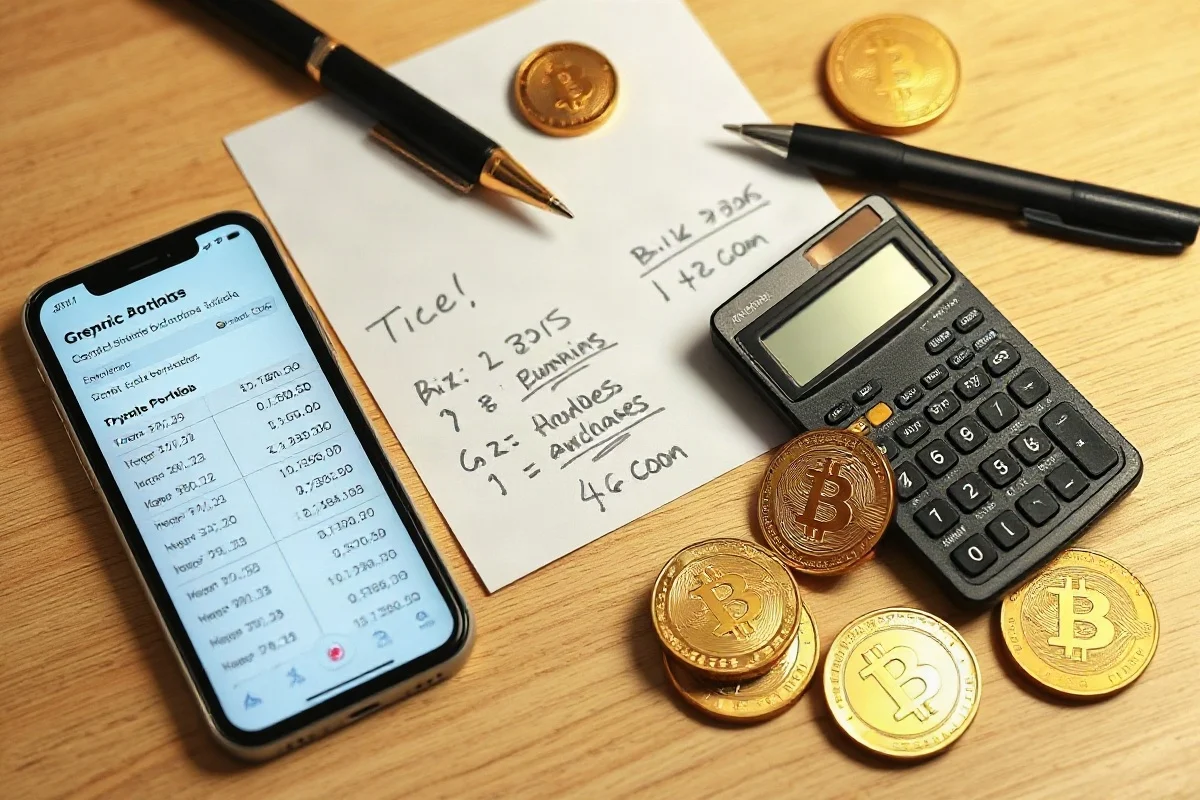
Buying the same altcoin at different prices changes your average cost based on how much money you invest at each price, not simply on the number of purchases. Your average cost is calculated by dividing your total purchase cost, including applicable fees, by the total number of coins you receive. Buying more units at a lower price can reduce your average cost, while buying more units at a higher price can increase it.
This calculation is useful for understanding your position, estimating a break-even price, and comparing different purchase plans. It does not predict whether an altcoin will rise or fall. Altcoins can experience substantial price volatility, limited liquidity, technical problems, or changes in market demand. Treat the examples below as educational illustrations rather than personalized investment advice.
The basic average-cost formula
The core formula is:
Average cost per coin = Total amount spent ÷ Total number of coins received

For multiple purchases, calculate each order separately:
- Coins received: Amount invested ÷ purchase price
- Total amount spent: Sum of the money used for all purchases, including fees if those fees are paid from the purchase amount
- Total coins received: Sum of the coins received from every purchase
- Average cost: Total amount spent ÷ total coins received
The formula assumes that all purchases involve the same altcoin and that the units are consistent. If one transaction is quoted in U.S. dollars and another in a different currency, convert the amounts using an appropriate exchange rate before combining them. Exchange rates and transaction costs may be time-sensitive, so verify the figures in your account records or current fee disclosures.
Example: two purchases at different prices
Suppose an investor makes two hypothetical purchases:
- $500 of an altcoin at $10 per coin
- $500 of the same altcoin at $5 per coin
The first purchase buys:

$500 ÷ $10 = 50 coins
The second purchase buys:
$500 ÷ $5 = 100 coins
The total investment is $1,000, and the total position is 150 coins. Therefore:
$1,000 ÷ 150 coins = $6.67 average cost per coin
The average cost is $6.67, not $7.50. A simple average of the two prices would be misleading because the same dollar amount bought different numbers of coins at each price. The lower-priced purchase acquired twice as many coins, so it has more influence on the average cost.
कीमतों का साधारण औसत गलत क्यों हो सकता है
Investors sometimes add purchase prices and divide by the number of purchases. That approach works only when the number of coins purchased is identical in every transaction. It does not work when the investor spends the same dollar amount at different prices, because each order creates a different position size.
Consider a different example:
- $100 invested at $4 per coin produces 25 coins
- $100 invested at $8 per coin produces 12.5 coins
The simple average of the prices is $6, but the actual average cost is:
$200 ÷ 37.5 coins = $5.33 per coin
The lower-priced purchase contributed more coins, which pulled the weighted average below the simple midpoint. This is why the total dollars and total units matter more than the number of transactions.
How unequal purchase amounts change the result
Your average cost also depends on how much you invest at each price. Buying a small amount at a low price may not lower the overall average very much if most of your position was purchased at a higher price.
For example, assume these hypothetical transactions:
- $900 at $9 per coin = 100 coins
- $100 at $3 per coin = 33.33 coins
The total investment is $1,000, and the total position is approximately 133.33 coins. The average cost is:
$1,000 ÷ 133.33 coins = approximately $7.50 per coin
Although the second purchase occurred at a much lower price, it represented only a small portion of the total investment. As a result, the average cost fell from $9 to approximately $7.50 rather than moving close to $3.
Fees, spreads, and slippage
The quoted coin price is not always the same as your effective cost. Depending on the platform and transaction type, your result may be affected by a trading fee, a spread between the displayed buy and sell prices, network costs, or slippage. These costs can be handled differently by different services.
If a $500 order has a $5 fee charged separately, your total cash outlay may be $505 while you receive coins based on the $500 trade amount. In that case, an economic cost calculation could use $505 as the amount paid and the actual number of coins received as the denominator. If the fee is deducted from the order itself, you may receive fewer coins, so use the exact filled quantity shown in your transaction history.
A practical formula is:
Effective average cost = Total cash outlay ÷ Total coins actually received
Do not assume that a platform’s displayed average price includes every cost. Review the order confirmation, execution details, withdrawal records, and fee schedule. Fees and execution conditions can change. You can also use a क्रिप्टो शुल्क कैलकुलेटर to organize fee assumptions, but confirm the final numbers against your transaction records.
Break-even price is not always the same as average cost
Average cost is a useful starting point, but it may not equal the exact price required to exit without a loss. If you must pay a selling fee, network fee, or other transaction cost, the required exit price may be higher than your average cost.
Ignoring fees, the position’s estimated unrealized result can be expressed as:
Estimated profit or loss = (Current price − Average cost) × Number of coins
With selling costs included:
Net result = Sale proceeds − purchase cost − selling costs − other applicable costs
For example, if your average cost is $6 per coin, a market price of $6 does not necessarily mean you can sell for exactly what you paid. The final result depends on the execution price, fees, spread, and the number of coins sold. A क्रिप्टो प्रॉफिट कैलकुलेटर can help model these variables when you enter your own verified figures.
What happens when you buy at a lower price?
Buying more of the same altcoin at a lower price generally reduces your average cost, assuming the new purchase is large enough relative to the existing position. However, a lower average cost does not remove the underlying market risk. It can also increase the total amount of capital exposed to the asset.
For instance, if an altcoin’s price declines because of a temporary market condition, adding to the position may produce a lower average cost. If the decline reflects a lasting problem with the project, token economics, liquidity, security, or broader market demand, additional buying can increase potential losses. The arithmetic benefit of a lower average cost should not be confused with evidence that the asset is undervalued or likely to recover.
What happens when you buy at a higher price?
Buying more at a higher price generally raises your average cost. This can happen when an investor adds to a position after a price increase. The new purchase may give the investor more exposure, but it also means that a larger portion of the position was acquired at a more expensive level.
Higher purchases are not automatically irrational, and lower purchases are not automatically attractive. The important questions are how the purchase fits within your risk limits, whether the transaction data is accurate, and whether the asset remains appropriate for your goals and circumstances. Those decisions require more than an average-cost calculation.
Average cost compared with dollar-cost averaging
Dollar-cost averaging, or DCA, usually means investing a predetermined amount on a schedule rather than attempting to choose a single entry price. When the asset price changes between purchases, the number of coins acquired also changes. A fixed-dollar approach buys more units at lower prices and fewer units at higher prices.
That process can produce a different average cost from buying the same number of coins at every interval. It also does not guarantee a profit or protect against a prolonged decline. A क्रिप्टो DCA कैलकुलेटर can help compare hypothetical schedules by showing the total invested, total units, and resulting average cost.
How to calculate your own position accurately
1. Gather complete transaction records
List every purchase of the same asset. Record the date, amount paid, execution price, quantity received, and fee. Include transfers only if they change the number of units in the position. Do not count deposits of fiat currency as purchases.
2. Use the filled quantity
Use the actual number of coins received rather than the estimated quantity shown before the order executes. Partial fills and price movement can make the final quantity different from the original estimate.
3. Separate purchases from sales
If you have sold part of the position, the remaining average cost depends on the accounting method used for your records. Do not automatically apply the original total cost to the remaining coins. Keep purchase and sale records organized, and consult a qualified tax professional for questions about reporting or cost-basis rules in your situation. Tax treatment can vary by jurisdiction and may change, so verify current information with an appropriate primary source or professional.
4. Recalculate after transfers and fees
A transfer between wallets may not be a new purchase, but a withdrawal fee can reduce the number of coins that arrive. Keep the transaction history for both the sending and receiving addresses. For wallet practices and operational risks, review reliable information in the वॉलेट और सुरक्षा अनुभाग देखें।
बचने योग्य सामान्य गलतियाँ
- Averaging prices without weighting: Use total cost divided by total units.
- शुल्कों को नज़रअंदाज़ करना: Include costs according to how they were charged and use the actual quantity received.
- Confusing market value with cost: Current value changes with the market and is not the same as the amount originally invested.
- Assuming a lower average guarantees recovery: Average cost is an accounting measurement, not a market forecast.
- Using stale price data: Prices, liquidity, spreads, and fees are time-sensitive. Verify current data before making calculations or transactions.
- Adding to a position solely to lower the average: A lower number can create a false sense of safety while increasing exposure to the same asset.
Using the calculation responsibly
Knowing your average cost can make portfolio records clearer and help you estimate the price at which a position might cover its original cost before fees. It should be used alongside position sizing, liquidity checks, security practices, and an honest assessment of how much volatility you can tolerate.
Before making another purchase, confirm the asset, network, wallet address, order size, execution method, and current fees. Check project information through authoritative sources rather than relying only on social media or a price chart. Cryptocurrency markets are volatile, and calculations based on historical purchases cannot establish future performance.
The central rule is simple: add the money spent, add the coins received, and divide total cost by total units. Once fees, sales, transfers, and partial fills are included correctly, your average cost becomes a more useful record of what the position has actually cost you—without turning that record into a promise about what the market will do next.

Comments
0No comments yet. Be the first to share a helpful note or question.
Leave a Comment
Your email address will not be published. Comments are reviewed before appearing on the site.