
Your ETH cost basis is the total amount you paid to acquire your Ethereum, including eligible transaction costs, divided by the amount of ETH you received when you need a per-coin figure. In a simple example, if you spend $2,000 to buy 1 ETH and pay a $20 purchase fee, your total cost basis is $2,020, or $2,020 per ETH. This figure helps you compare your acquisition cost with a later value, but it is not a guarantee of profit and does not by itself determine your tax treatment.
What ETH cost basis means
Cost basis is the starting value used to measure how much an asset has gained or lost relative to its acquisition cost. For Ethereum, the calculation can become more involved when you make several purchases, pay trading fees in different currencies, transfer ETH between wallets, receive staking rewards, or exchange ETH for another asset.
For educational tracking, the basic idea is straightforward:
Total ETH cost basis = purchase amount + eligible acquisition fees

To calculate the average cost basis per ETH:
Average cost basis per ETH = total cost basis ÷ total ETH acquired
These formulas describe recordkeeping concepts. The treatment of fees, transfers, staking income, gifts, and other transactions can depend on the facts and the rules that apply to you. Tax rules are time-sensitive and may vary by jurisdiction, so verify current guidance with the relevant tax authority or a qualified tax professional before filing.
A simple ETH cost basis example
Assume the following educational example:
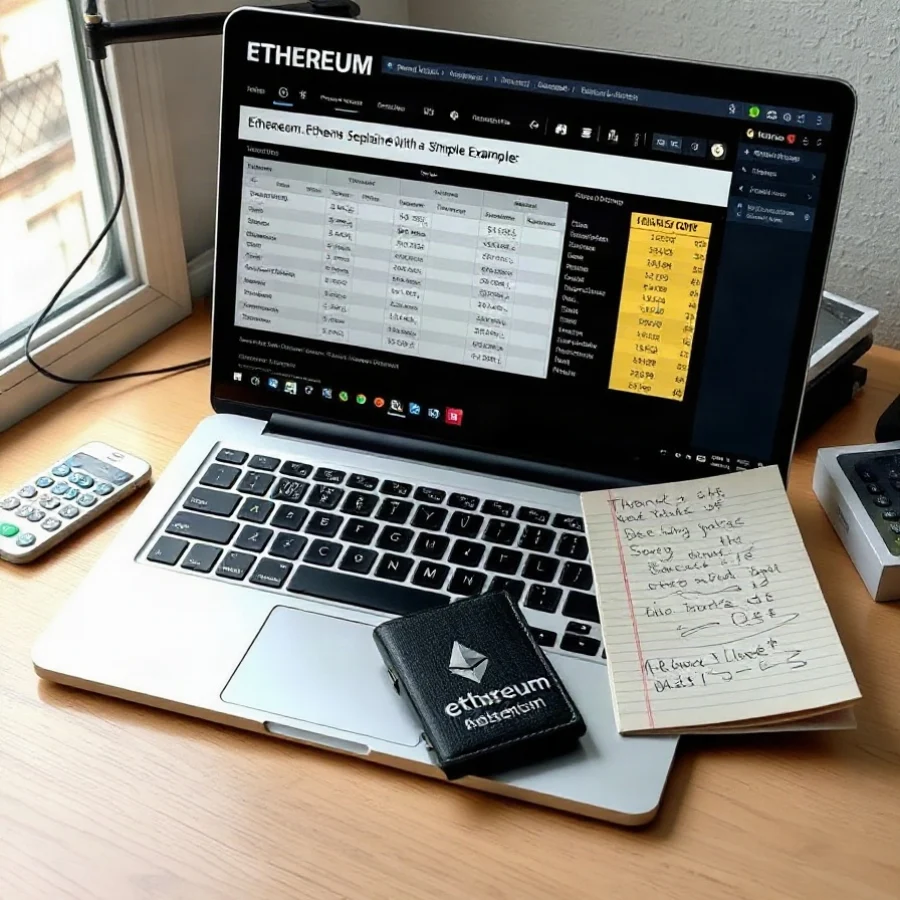
- You buy 1 ETH for $2,000.
- You pay a $20 exchange or transaction fee.
- You do not sell, transfer, stake, or otherwise use the ETH in this example.
First, add the purchase amount and the fee:
$2,000 + $20 = $2,020 total cost basis
Because you acquired 1 ETH, the per-ETH basis is:
$2,020 ÷ 1 ETH = $2,020 per ETH
If you later observe a market price of $2,400, the difference between that reference price and your basis would be $380 per ETH before considering any later selling costs or other adjustments:
$2,400 − $2,020 = $380
That is an unrealized difference while you still hold the ETH. It is not a guaranteed return, and the displayed market price can change continuously. A realized gain or loss generally involves a disposal, such as a sale or exchange, but the applicable rules and calculation method should be confirmed for your situation.
How to calculate cost basis when you buy less than one ETH
You do not need to purchase a whole ETH. Suppose you spend $600 and receive 0.25 ETH after paying a $6 fee. If the fee is included in the acquisition cost for your tracking method, the calculation is:
Total cost basis = $600 + $6 = $606
Cost basis per ETH = $606 ÷ 0.25 = $2,424 per ETH
The $2,424 figure is a normalized per-ETH number. You still own only 0.25 ETH, so the total basis attached to your holding remains $606 under this example. A common mistake is to confuse a per-unit basis with the total amount invested.
Calculating ETH basis across multiple purchases
Many people acquire ETH over time instead of making one purchase. Consider this simplified record:
| 購入 | 受け取ったETH | Purchase amount | Fee | Total basis |
|---|---|---|---|---|
| 1 | 0.50 ETH | $1,000 | $10 | $1,010 |
| 2 | 0.25 ETH | $600 | $6 | $606 |
| 3 | 0.25 ETH | $800 | $8 | $808 |
Now add the ETH amounts and the basis amounts:
Total ETH = 0.50 + 0.25 + 0.25 = 1.00 ETH
Total basis = $1,010 + $606 + $808 = $2,424
Average basis per ETH = $2,424 ÷ 1.00 = $2,424
In this example, the average basis happens to equal the per-ETH basis from the second example because the combined numbers were selected for simplicity. In real records, the result will depend on the amount of ETH acquired, the price of each purchase, and the fees associated with each transaction.
Why fees matter
Fees can affect your calculations in two different ways. A fee paid to acquire an asset may increase the amount recorded as the acquisition cost under a particular accounting or tax treatment. A fee paid when selling or disposing of ETH may reduce the proceeds used to measure the result. Network fees can be especially confusing because they may be paid in ETH, deducted by a platform, or associated with a wallet transfer rather than a purchase.
Do not assume that every fee should be handled identically. Record the fee currency, the amount, the transaction date, the related transaction, and the platform or wallet involved. The Crypto Fee Calculator can help you organize fee amounts for general planning, but it does not replace transaction records or professional tax guidance.
Cost basis and unrealized profit or loss
Once you know your basis, you can compare it with a current reference value. For a basic holding with no complications, an estimated unrealized profit or loss can be expressed as:
Estimated unrealized profit or loss = current ETH value − cost basis
Current ETH value can be estimated as:
Current ETH value = ETH quantity × reference ETH price
For example, if your holding is 0.5 ETH, your total basis is $1,000, and a reference price is $2,300, the estimated current value is $1,150:
0.5 × $2,300 = $1,150
The estimated difference is:
$1,150 − $1,000 = $150
This calculation excludes possible selling fees, spreads, slippage, taxes, and changes in the reference price. Prices are time-sensitive, and an exchange quote, index price, or portfolio display may differ from the price at which you could actually execute a transaction. For broader calculations, you can use the Crypto Profit Calculators as an educational tool.
Average cost versus specific lots
When you buy ETH at different prices, you may need to track individual acquisition lots rather than relying only on one average. An average cost view is useful for understanding your overall position, but it can hide the details of each purchase. A lot-based record identifies the date, quantity, price, fees, and remaining amount connected with a particular acquisition.
For example, if you bought 0.4 ETH at one price and 0.6 ETH at another, a later sale of 0.2 ETH may require you to identify which units were disposed of under the method applicable to your records. Do not choose a method merely because it produces a preferred result. Recordkeeping and tax requirements can vary, and methods may have documentation or consistency requirements. Verify the current rules that apply to you.
Special situations that can change the calculation
ETH transfers between your own wallets
Moving ETH between wallets you control is different from buying ETH. A transfer generally should not be treated as a new purchase simply because it appears as a new wallet transaction. Keep the original acquisition date, quantity, and basis connected to the coins, while separately recording any network fee and the wallet addresses involved. The exact treatment can depend on the nature of the transfer and applicable rules.
ETH received from staking or other activities
ETH received through staking, employment, a promotion, a protocol activity, or another source may not have the same recordkeeping path as ETH purchased with cash. The relevant value, receipt date, and later disposition information may matter. Staking arrangements and their tax treatment can change, and platform reports may not contain every detail you need. Keep source records and verify current guidance before relying on an automated basis calculation.
Swapping ETH for another crypto asset
An ETH-to-token swap is not the same as simply moving ETH between accounts. It involves disposing of one asset and receiving another. You should record the ETH amount, the value used for the transaction, network and trading fees, the asset received, and the transaction identifier. A crypto converter can help with unit comparisons, but its displayed conversion rate is time-sensitive and should not be treated as a permanent market value.
A practical ETH cost basis recordkeeping checklist
- Record the date and time of every purchase, sale, swap, reward, and transfer.
- Save the ETH quantity and the amount paid or received in the transaction currency.
- Separate trading fees, network fees, spreads, and withdrawal charges where the records identify them.
- Keep exchange confirmations, wallet records, transaction IDs, and exported account history.
- Track transfers between your own wallets so you do not mistake them for new acquisitions.
- Reconcile exchange reports with blockchain activity and your bank or payment records.
- Back up your files securely and protect wallet credentials and account access.
Blockchain data is public, but it does not automatically tell you who controlled an address, what an asset cost in dollars, or how a transaction should be classified. Good records connect on-chain activity with your own account history without exposing private keys or recovery phrases.
避けるべきよくある間違い
One frequent mistake is using the current ETH price as the cost basis. The current price is a market reference; basis is tied to how and when you acquired the asset. Another mistake is calculating only the purchase price while ignoring relevant fees or failing to record fees paid in ETH. It is also easy to count a wallet transfer as a second purchase, lose track of partial sales, or rely on a single exchange report when assets moved across several platforms.
Automated portfolio tools can save time, but they may mislabel transfers, omit unsupported wallets, or use assumptions that do not match your records. Review imported transactions instead of accepting every result without checking.
Using the result responsibly
Cost basis is a measurement tool, not a prediction. A lower basis does not mean an asset must rise, and a higher basis does not mean selling is automatically appropriate. Ethereum prices, network conditions, fees, platform policies, and regulatory or tax guidance can change. Verify current information with primary sources and consider qualified professional advice for decisions involving significant funds or complex transactions.
For educational planning, start with a complete transaction history, calculate each acquisition separately, and then choose a clearly documented method for summarizing or matching those records. The Crypto DCA Calculator may help illustrate how repeated purchases affect an average entry price, while the final record should remain consistent with your actual transactions and applicable requirements.


Comments
0No comments yet. Be the first to share a helpful note or question.
Leave a Comment
Your email address will not be published. Comments are reviewed before appearing on the site.