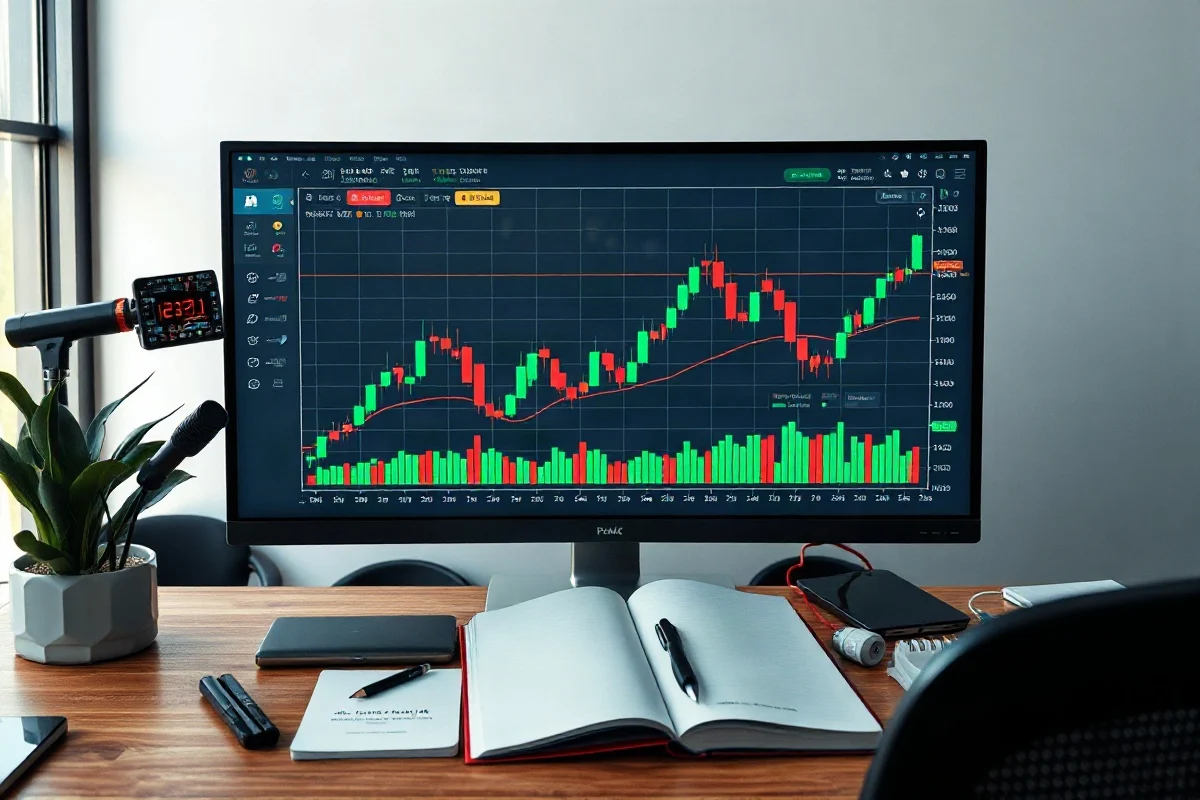
Crypto prices go up when buying demand is stronger than available selling pressure, and they go down when sellers are more motivated than buyers. That basic supply-and-demand relationship is affected by liquidity, market sentiment, network activity, token supply, interest rates, regulation, news, and the actions of large market participants. Because crypto markets operate continuously and can be relatively volatile, prices may change quickly even when the underlying technology or project has not changed.
This article explains the main forces behind crypto price movements in practical terms. It is educational information, not personalized investment advice. Prices, fees, market conditions, and regulatory requirements can change, so verify current information with reliable market data providers, exchanges, project documentation, and relevant government or regulatory sources.
Supply and demand are the foundation
Every traded asset has a market price created by the interaction of buyers and sellers. If more participants are willing to buy at increasingly higher prices, the market price may rise. If more participants want to sell and buyers are unwilling to match their asking prices, the market price may fall.
Crypto supply has several different meanings:
- Circulating supply: Tokens believed to be available in the market.
- Total supply: Tokens that have been created, excluding some categories such as permanently destroyed tokens, depending on the data source.
- Maximum supply: The highest number of tokens that can exist under a protocol's rules, if a maximum is defined.
- Available liquidity: The amount that can be bought or sold near the current price without causing a large price change.
A token can have a large total supply but limited liquidity on exchanges. In that situation, relatively modest orders may move the quoted price more than many investors expect. Conversely, a highly liquid market may absorb larger orders with less immediate price impact.
How market capitalization relates to price
Market capitalization is commonly estimated with this formula:
Market capitalization = price per token × circulating supply
For example, an educational calculation might assume a token price of $2 and a circulating supply of 50 million tokens. The implied market capitalization would be $100 million. This is only a mathematical example, not a statement about any real asset or future valuation.

Market capitalization does not mean that an amount equal to the market cap has entered the project. It is a valuation estimate based on the latest quoted price multiplied by a supply figure. If the supply data is incomplete, disputed, changing, or reported differently by data providers, the resulting market cap can also be uncertain. You can explore the relationship between supply and valuation with a 時価総額計算機.
Liquidity and order books can magnify price moves
Liquidity describes how easily an asset can be bought or sold without substantially changing its price. In a traditional exchange order book, buyers place bids and sellers place asks. The difference between the best available buy and sell prices is called the spread.
When an asset has deep liquidity, a market order may be matched across many nearby orders. When liquidity is thin, the same order may consume several price levels. This is known as slippage: the execution price differs from the price a trader expected.
Low liquidity can make both upward and downward movements sharper. A burst of buying may remove nearby sell orders, while a wave of selling may remove nearby bids. Prices shown on different platforms may also vary because exchanges have separate order books, user bases, trading pairs, and liquidity conditions.
News and expectations move markets
Crypto markets often respond to information before its effects can be measured in official data. Traders may buy or sell based on expectations about an event rather than the event itself. Examples can include:
- Protocol upgrades or changes to a blockchain's operation
- New exchange listings or delistings
- Security incidents, outages, or smart-contract vulnerabilities
- Adoption announcements, partnerships, or product launches
- Changes in token distribution, unlock schedules, or governance decisions
- Regulatory proposals, enforcement actions, or court developments
- Macro market news, such as interest-rate expectations or changes in risk appetite
An announcement is not automatically proof that a token's value will rise or fall. Markets can react positively, negatively, or not at all, depending on how the information compares with existing expectations. Some moves are later reversed when the initial interpretation changes or when traders take profits.
Investor sentiment and market psychology
Sentiment reflects how optimistic, fearful, or uncertain market participants are. During optimistic periods, rising prices may attract additional buyers who fear missing a move. This can create momentum. During fearful periods, falling prices may encourage more selling, especially when traders use leverage or have strict risk limits.
Social media, online communities, influencers, headlines, and search activity can amplify sentiment. However, popularity is not the same as fundamental value, and online claims may be incomplete, promotional, or false. A sudden increase in attention can bring both new demand and greater volatility.
Behavioral effects such as confirmation bias, loss aversion, and herd behavior can influence decisions. Investors may focus on information that supports their existing view, hold losing positions longer than planned, or buy after a substantial increase because recent performance feels persuasive. These patterns can contribute to rapid price swings without establishing a reliable direction.
Bitcoin and broader market influence
Bitcoin is often watched as a measure of overall crypto market sentiment because it has a large market presence and is widely traded. When Bitcoin moves sharply, other crypto assets may respond as traders adjust exposure across the market. The relationship is not fixed: individual assets can behave differently because of their own supply schedules, development activity, liquidity, and investor base.
Some altcoins are more sensitive to changes in risk appetite than larger, more liquid assets. They may rise faster during speculative periods and fall faster when liquidity leaves the market. Comparing assets requires more than comparing their token prices; supply, market capitalization, liquidity, use case, and dilution risk also matter. See the crypto prices guide for broader price-related topics.
Token supply, issuance, and unlocks
A crypto asset's supply can change over time. New tokens may be issued as rewards for validators, miners, liquidity providers, or other participants. Some protocols also burn tokens, while others use fees or governance rules that affect future issuance.
Scheduled token unlocks can increase the amount available to early investors, team members, foundations, or other holders. An unlock does not guarantee that those tokens will be sold, but market participants may consider the possibility of additional selling pressure. To evaluate a token, check current project documentation and independent supply data rather than relying on an old supply figure.
Inflation and dilution can affect how investors interpret a price increase. If the token supply grows, the price may need to rise simply to maintain the same market capitalization. Conversely, a token burn does not automatically create demand or guarantee a higher price.
Interest rates and the macroeconomic environment
Crypto markets are influenced by broader financial conditions. When investors perceive cash and low-risk assets as more attractive, they may reduce exposure to volatile assets. When liquidity and risk appetite increase, some investors may allocate more capital to assets such as crypto. These relationships can change across market cycles and are not reliable short-term predictors.
Inflation data, employment reports, central-bank decisions, currency movements, bond yields, and geopolitical events can all affect investor expectations. A market may react before a scheduled announcement, then move in the opposite direction once the actual information is released.
Leverage, liquidations, and derivatives
Derivatives markets allow traders to take positions based on expected price movements, sometimes with borrowed funds. Leverage increases the size of a position relative to the trader's capital, which can magnify both gains and losses.
If a leveraged position falls below an exchange's maintenance requirements, it may be liquidated. Forced selling can add downward pressure during a decline. Similarly, short positions may be closed when prices rise, creating additional buying pressure. These liquidation effects can accelerate an already active move, although they do not determine the market's long-term value.
Because leverage introduces substantial risk, price charts alone may not reveal how much movement is connected to derivatives positioning. Investors should understand liquidation rules, funding costs, collateral requirements, and counterparty risks before using such products. These details are platform-specific and time-sensitive.
How to calculate a crypto price change
A simple percentage change formula is:
変化率 = ((新しい価格 − 古い価格) ÷ 古い価格) × 100
For an educational example, assume an asset moves from $100 to $120:
((120 − 100) ÷ 100) × 100 = 20%
If it then falls from $120 back to $100, the decline is:
((100 − 120) ÷ 120) × 100 = −16.67%
This illustrates why a loss and a gain of the same percentage do not cancel each other out. A 20% loss from $100 produces $80, and a 20% gain from $80 produces $96. Trading fees, spreads, slippage, taxes, and other costs are excluded from this basic example. For a more complete estimate, use a 暗号資産利益計算機 and enter accurate transaction details.
Practical ways to analyze a price move
Check the time frame
A one-minute movement may reflect order flow or liquidation activity, while a multi-month trend may reflect adoption, supply changes, macroeconomic conditions, or changing market expectations. Avoid treating a short-term chart pattern as a complete explanation of long-term value.
Separate price from value
A lower token price does not necessarily mean an asset is cheap, and a higher token price does not necessarily mean it is expensive. Review market capitalization, circulating and future supply, liquidity, network usage, competition, security history, and project disclosures.
Verify the source and timestamp
Price feeds can differ, and information becomes outdated quickly. Check whether data is based on a particular exchange, trading pair, or calculation method. For protocol details, consult the project's official documentation and blockchain data where appropriate. For legal, tax, or regulatory questions, consult current primary sources and a qualified professional familiar with your situation.
Account for total transaction costs
The result of a trade is not determined by the quoted price alone. Spreads, exchange fees, network fees, withdrawal charges, conversion costs, and slippage can affect the outcome. Costs vary by platform, asset, network conditions, and account type. A 暗号資産手数料計算機 can help organize assumptions, but its result is only as accurate as the information entered.
Why price predictions are uncertain
Crypto prices reflect the combined decisions of many participants, often using incomplete and conflicting information. New events can change demand, liquidity, or expectations without warning. Historical performance and technical indicators may help describe what happened, but they cannot guarantee what will happen next.
A careful analysis should identify its assumptions, show the calculation method, and acknowledge uncertainty. No calculator can remove market risk, and no price model can guarantee a profit. Consider whether a potential loss would be financially manageable, protect account credentials and wallet recovery information, and avoid making decisions based solely on hype or a single price target.


Comments
0No comments yet. Be the first to share a helpful note or question.
Leave a Comment
Your email address will not be published. Comments are reviewed before appearing on the site.