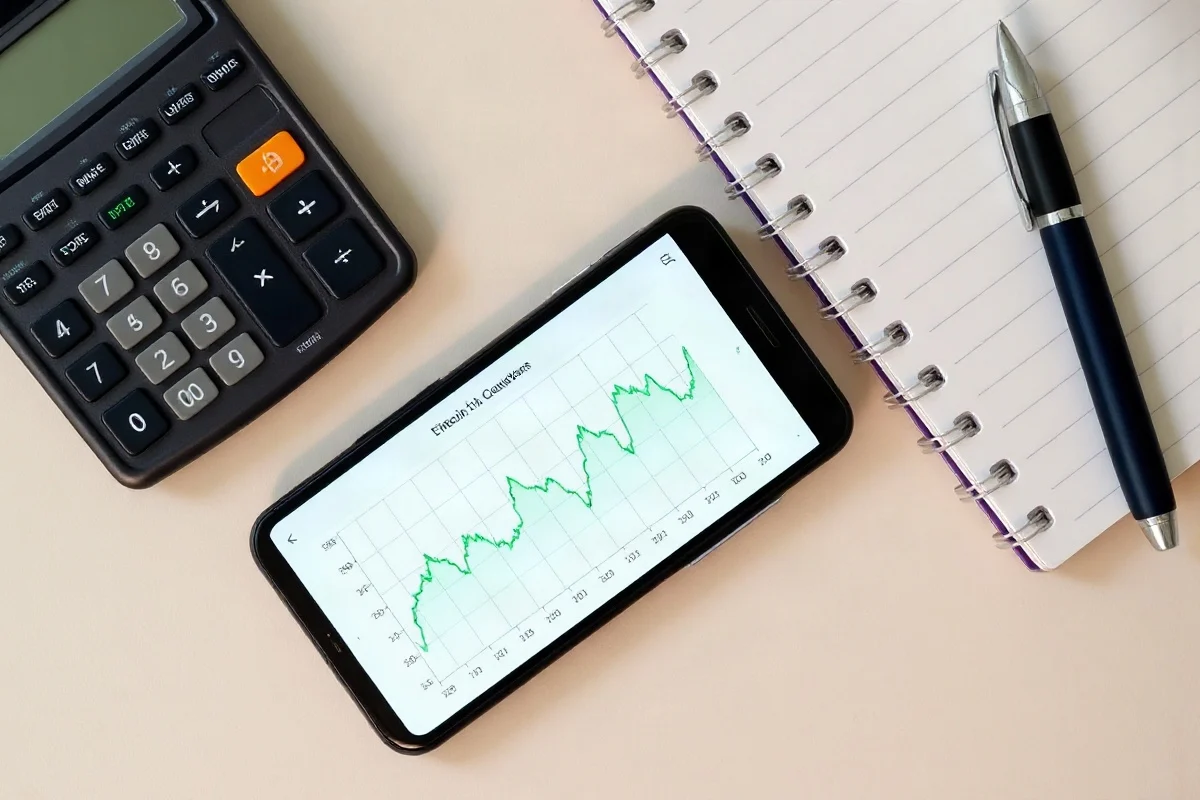
To double a Bitcoin investment, Bitcoin generally needs to reach approximately twice your average purchase price, assuming no fees, taxes, additional purchases, or other costs. For example, if your average cost basis is $40,000 per BTC, a price near $80,000 would represent a 100% gain before expenses. The exact target depends on how much Bitcoin you own, your average entry price, trading fees, withdrawal costs, taxes, and whether you mean doubling the account value or your after-tax cash.
This is a mathematical estimate, not a prediction that Bitcoin will reach a particular price. Bitcoin is highly volatile, and market prices can change rapidly. Use current market data from a reputable exchange, broker, or other primary market source when applying the formula to your own holdings.
The basic formula for doubling a Bitcoin investment
When you make one Bitcoin purchase and ignore costs, the calculation is straightforward:
Target Bitcoin price = Initial Bitcoin price × 2

You can also calculate the result from your investment amount and the amount of Bitcoin purchased:
Target price = (Initial investment × 2) ÷ Bitcoin amount owned
These formulas work because the quantity of Bitcoin stays constant while its market value changes with the price. If you buy $1,000 worth of Bitcoin at an average price of $50,000, you own 0.02 BTC before fees. If Bitcoin later reaches $100,000, that holding would be worth $2,000 before transaction costs and taxes.
The percentage return is calculated as:

Return percentage = [(Current value − Initial investment) ÷ Initial investment] × 100
A 100% return means the gain equals the original investment. The total position value is then approximately twice the starting amount. This is different from a 200% return, which would mean a gain equal to two times the initial investment and a total value of roughly three times the starting amount.
Why your average purchase price matters
Many Bitcoin investors buy at more than one price. In that case, the relevant figure is not necessarily the price of your most recent purchase. You need an average cost basis, which reflects the total amount spent divided by the amount of Bitcoin acquired.
Average cost basis = Total purchase cost ÷ Total Bitcoin acquired
Suppose an educational example includes two purchases:
- $600 spent to buy 0.012 BTC
- $400 spent to buy 0.008 BTC
The total spent is $1,000 and the total holding is 0.020 BTC. The average cost basis is therefore $50,000 per BTC. Ignoring fees and taxes, a Bitcoin price of $100,000 would make the position worth $2,000, or approximately twice the original amount.
Real portfolios may be more complicated. You might have received Bitcoin as compensation, transferred it between wallets, sold part of the position, or made purchases through a recurring investment plan. For a series of purchases, record each transaction and calculate the remaining cost basis using a method appropriate to your records and applicable tax rules. Tax treatment can vary by jurisdiction and individual circumstances, so verify current information with an official tax authority or a qualified tax professional.
How fees change the price target
A simple doubling calculation usually assumes that every dollar invested becomes Bitcoin and that selling costs nothing. Actual transactions may include trading spreads, commissions, network fees, withdrawal charges, custody costs, or other expenses. The available charges depend on the platform and can change over time, so check the platform’s current fee schedule before calculating a target.
If your goal is to double the amount of money you originally deposited after selling, the Bitcoin price must be high enough to cover both the purchase and sale costs. A practical approach is:
- Calculate the amount of Bitcoin actually received after the purchase.
- Determine the cash value needed to cover your original deposit and the expected selling costs.
- Divide that required cash value by the Bitcoin amount you hold.
For example, if you deposit $1,000 but fees leave you with Bitcoin worth slightly less than $1,000 at the purchase price, a price exactly twice your quoted entry price may not produce a full 100% net return. The difference may be small or significant depending on the platform, order type, spread, and transaction size. Our Crypto Fee Calculator can help you model costs, but you should still confirm the final fee details with your provider.
Calculating the target from your current Bitcoin position
If you already know how much Bitcoin you own and how much you invested, you can calculate the target directly:
Target price = Desired portfolio value ÷ Bitcoin held
To double the original investment, set the desired portfolio value to two times the starting investment. In an illustrative example, assume you invested $2,500 and currently hold 0.04 BTC. The price required for the holding to be worth $5,000 is:
$5,000 ÷ 0.04 BTC = $125,000 per BTC
This result is only a calculation based on the stated assumptions. It does not account for fees, taxes, changes in the amount held, or the possibility that the market price may not reach the target.
Doubling an investment versus doubling the Bitcoin price
For a single purchase, doubling the Bitcoin price and doubling the investment value produce the same result before costs. However, the two ideas can diverge when your position changes.
If you buy more Bitcoin later, your total investment increases. A price that would have doubled the original purchase may no longer double the entire portfolio. Likewise, selling part of your holding reduces the amount of Bitcoin exposed to future price movements. Transfers, rewards, and other transactions can also affect your records.
For investors making regular purchases, the average price may be more useful than any single market price. A Crypto DCA Calculator can help illustrate how repeated contributions affect the total amount invested, the Bitcoin accumulated, and the average purchase price. These are scenario tools, not forecasts.
What a Bitcoin profit calculator can show
A profit calculator can compare an entry price, exit price, investment amount, and Bitcoin quantity. Depending on the tool, it may also allow you to include fees or calculate the return percentage.
The core calculation is:
Profit or loss = Current value − Total cost
ROI = (Profit or loss ÷ Total cost) × 100
For an illustrative example, a $750 purchase that grows to $1,125 has a $375 gain and a 50% return before costs. It has not doubled, because the position is worth 1.5 times the original amount. A doubled position would be worth $1,500, representing a $750 gain and a 100% return before costs.
You can enter your own assumptions into a Crypto Profit Calculator. When doing so, distinguish between an estimated market value and the amount you would actually receive after selling. Market prices, spreads, and fees may produce different results.
Risks behind a Bitcoin price target
A target price is not a timetable. Bitcoin may rise, fall, trade sideways, or experience sharp price swings. Historical performance does not guarantee future results, and a calculation cannot predict market demand, liquidity, macroeconomic conditions, technological developments, security events, or regulatory changes.
There is also a risk in focusing only on the price needed to double. Bitcoin can decline substantially before reaching a target, and an investor may sell early because of fear or hold too long because of unrealistic expectations. A target can be useful for understanding the numbers, but it should not replace a broader plan for position sizing, custody, liquidity needs, and risk tolerance.
Security matters as well. Losing access to a wallet, sending funds to the wrong address, or falling for a phishing attack can affect the value of an investment regardless of Bitcoin’s market price. Review wallet and account security practices through reliable sources, and never share a recovery phrase or private key.
A practical checklist for your calculation
- List every relevant Bitcoin purchase and the amount acquired.
- Add the purchase costs and calculate your average cost basis.
- Confirm the amount of Bitcoin currently held after transfers and sales.
- Estimate purchase, sale, spread, withdrawal, and network costs without assuming they are fixed.
- Calculate the gross target price and then adjust your estimate for expected costs.
- Review current market prices from a reliable source before making any decision.
- Consider tax and reporting consequences using current official guidance or professional advice.
In short, the quick answer is that Bitcoin usually needs to reach about twice your average purchase price for your investment to double before fees and taxes. A more accurate target requires your actual Bitcoin amount, complete transaction history, current platform costs, and the specific meaning of “double” in your situation. Treat the result as an educational scenario rather than a promise of profit or personalized investment advice.



Comments
0No comments yet. Be the first to share a helpful note or question.
Leave a Comment
Your email address will not be published. Comments are reviewed before appearing on the site.