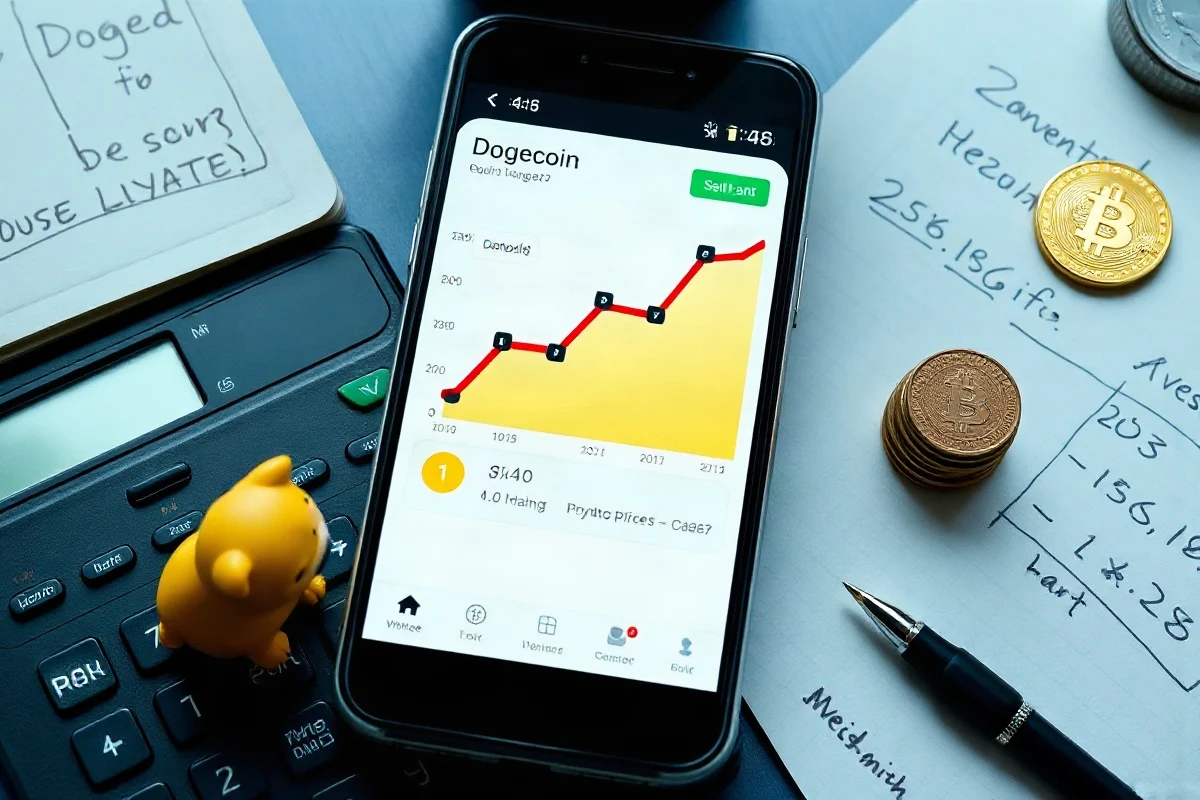
Different Dogecoin price targets can produce very different portfolio outcomes, but the result depends on your entry price, investment amount, number of DOGE purchased, transaction costs, and whether the target is ever reached. The basic estimate is straightforward: multiply your DOGE holdings by a hypothetical future price, then subtract your original investment and relevant costs. Because DOGE is highly volatile, these examples are educational scenarios—not predictions or personalized investment advice.
How to calculate what a Dogecoin price target could mean
To estimate the value of a Dogecoin position at a hypothetical target, use this formula:
Future value = Number of DOGE × Hypothetical DOGE price
To estimate the potential gain or loss before taxes:
Potential gain or loss = Future value − Initial investment − Transaction costs
You can also calculate the percentage return:
ROI = (Potential gain or loss ÷ Initial investment) × 100
For a simple example, assume an investor spends $500 on DOGE at an entry price of $0.10 per coin and pays no fees in the illustration. The investor would hold 5,000 DOGE:

$500 ÷ $0.10 = 5,000 DOGE
If DOGE later reached a hypothetical price of $0.20, the position would be worth $1,000. The gross gain would be $500, or 100%, before any trading costs, taxes, or other expenses. This example does not suggest that the target is likely or that a particular return is achievable.
Example Dogecoin price target scenarios
The following table uses the same assumptions throughout: a $500 initial investment, a $0.10 entry price, and 5,000 DOGE purchased. The target prices are hypothetical and are provided only to demonstrate the mechanics of a price-target calculation.
| Hypothetical DOGE price | Value of 5,000 DOGE | Gross gain or loss | Illustrative ROI |
|---|---|---|---|
| $0.05 | $250 | -$250 | -50% |
| $0.10 | $500 | $0 | 0% |
| $0.15 | $750 | $250 | 50% |
| $0.20 | $1,000 | $500 | 100% |
| $0.50 | $2,500 | $2,000 | 400% |
| $1.00 | $5,000 | $4,500 | 900% |
The table shows why a coin price alone is not enough to evaluate an investment. The number of coins held and the original purchase price are equally important. An investor who buys at a higher entry price may need a much larger DOGE move to reach the same percentage return. Likewise, an investor who buys at a lower price may still face a loss if the market declines afterward.
Price targets are not the same as profit forecasts
A price target is a hypothetical level used for planning or analysis. It is not a guarantee, and it may be based on assumptions that change quickly. Crypto markets can react to broad market sentiment, liquidity, bitcoin market conditions, technology developments, social-media activity, exchange availability, and other factors that are difficult to forecast reliably.
Dogecoin also has characteristics that can make target-based analysis especially uncertain. Its market price can move sharply over short periods, and public attention may influence trading activity. A target that appears reasonable in one market environment may become unrealistic—or may be exceeded quickly—in another. Historical price behavior does not establish that the same pattern will occur again.
Before using any target, ask what supports it. Is it based on a technical chart level, a market-cap comparison, a personal planning threshold, or a social-media prediction? These are different types of assumptions and should not be treated as equivalent evidence.
Market capitalization can put a target in context
Coin price comparisons can be misleading because different cryptocurrencies have different circulating supplies. A price of $1 does not have the same market-caplication implication for every asset.
The basic market capitalization formula is:
Market capitalization = Coin price × Circulating supply
For a hypothetical target, the implied market capitalization would be:
Implied market capitalization = Hypothetical DOGE price × Current circulating supply
Because circulating supply can change and market data providers may use different methodologies, verify the current supply figure with a reputable, up-to-date primary or market-data source before drawing conclusions. You can use the Market Cap Calculator to examine how price and supply interact, but the output remains dependent on the inputs you provide.
Market capitalization is also not the same as the amount of money that must flow into an asset to produce a particular price. Order books, liquidity, trading volume, and market conditions affect execution. A simple market-cap calculation is useful for context, but it does not model the full process of buying or selling.
Include fees, spreads, and slippage
Basic examples often assume that the entire investment is converted into DOGE at the displayed price. Real transactions may include a trading fee, a withdrawal fee, a spread between the quoted buy and sell prices, and slippage caused by changing market conditions or limited liquidity.
A more realistic estimate begins with the amount actually invested after purchase costs:
Net amount used to buy DOGE = Cash invested − purchase fee
You can then estimate the number of coins purchased as:
DOGE purchased = Net amount used to buy DOGE ÷ execution price
When selling, subtract the selling fee and account for the actual execution price. The difference between a displayed price and the price received can materially affect a small or frequently traded position. The Crypto Fee Calculator can help you test fee assumptions, but exchange charges are time-sensitive. Check the current fee schedule and transaction details for the platform you use.
How dollar-cost averaging changes the calculation
Many investors do not make one purchase at one price. Instead, they buy a fixed dollar amount on a schedule. This approach is commonly called dollar-cost averaging, or DCA. It can produce a different average entry price because each purchase occurs at a different market price.
For multiple purchases, calculate total units and total cost:
Total DOGE purchased = DOGE from purchase one + DOGE from purchase two + each later purchase
Average entry price = Total purchase cost ÷ Total DOGE purchased
For example, an investor might make three hypothetical $100 purchases at three different prices. The number of DOGE received in each transaction would be $100 divided by that transaction's execution price. Adding those amounts gives total holdings. Dividing the total $300 cost by the total holdings gives the average entry price.
This calculation is more accurate than averaging the listed prices, because each purchase may acquire a different number of coins. Fees should be included in the total cost or deducted from the amount converted, depending on how the platform charges them. The Crypto DCA Calculator can help compare scheduled purchases under different hypothetical prices and contribution amounts.
What can make a target difficult to reach?
Market-wide volatility
DOGE may be affected by movements across the broader cryptocurrency market. A strong bitcoin rally, a market-wide selloff, changing liquidity, or shifts in investor risk appetite can influence altcoin prices. These relationships are not fixed, so a move in one asset does not guarantee a corresponding move in another.
Supply and market-cap assumptions
A higher DOGE price implies a higher market capitalization if circulating supply remains unchanged. Supply data and market conditions should be checked at the time of analysis rather than treated as permanent assumptions.
Execution and liquidity
A price shown on a chart may not be the price available for the amount you want to buy or sell. Large orders, fast-moving markets, and thin order books can lead to slippage. This matters when estimating the amount actually received after a sale.
Behavioral risk
Investors may change their plan after a sharp price increase or decline. A written plan can define which assumptions are being tested, what level of loss would be unacceptable, and whether the position size is appropriate for the investor's circumstances. A plan cannot remove market risk, but it can make the calculation more disciplined.
Use scenarios instead of a single target
Relying on one optimistic target can hide the range of possible outcomes. A scenario analysis can include a lower price, a flat price, a moderate increase, and a highly optimistic increase. You can also calculate the break-even price after fees:
Break-even price = Total amount invested, including costs ÷ Total DOGE held
For a position with multiple purchases, the break-even price may be different from the price paid in any single transaction. If taxes or other obligations apply, the after-tax result may also differ from the trading calculation. Tax treatment is jurisdiction-specific and can change, so consult current guidance from the relevant tax authority or a qualified tax professional rather than relying on a general online example.
For a broader estimate, the Crypto Profit Calculator can compare an entry price, exit price, investment amount, and selected costs. Enter current market data yourself and verify every assumption before using the result for planning.
Practical questions to ask before using a DOGE target
- What entry price and purchase amount does the calculation assume?
- Are fees, spreads, and slippage included?
- Is the target based on a clear method, or simply on an online prediction?
- What implied market capitalization would the target represent?
- What happens to the position if DOGE falls instead of rises?
- Could you tolerate the full modeled loss without relying on the money for essential expenses?
- Have you checked current market data and platform fees from reliable sources?
These questions help separate a mathematical illustration from a realistic risk assessment. A calculator can show what would happen if a price were reached; it cannot establish that the price will be reached or determine whether the risk fits your financial situation.
Dogecoin price targets are most useful when treated as conditional scenarios. Start with accurate holdings and costs, calculate several outcomes, check the implied market capitalization, and account for volatility and potential losses. Review time-sensitive prices, fees, supply data, tax information, and regulatory developments using current primary sources. The final decision about whether to buy, hold, or sell is personal, and this article is for education rather than individualized financial advice.



Comments
0No comments yet. Be the first to share a helpful note or question.
Leave a Comment
Your email address will not be published. Comments are reviewed before appearing on the site.