
Electricity prices can determine whether a crypto mining operation produces a positive margin, breaks even, or loses money. The basic relationship is direct: higher electricity rates increase operating costs for every mined coin, while lower rates improve the margin—assuming the coin price, network difficulty, block reward, hardware efficiency, and other expenses remain unchanged. Because those factors can change quickly, mining profitability estimates are educational scenarios rather than guaranteed results.
Why electricity has such a large effect on mining returns
Mining hardware converts electricity into computational work. A mining machine consumes power continuously, and that consumption creates a recurring expense whether the machine earns more or fewer coins during a given period. This makes electricity different from one-time costs such as purchasing hardware. The equipment purchase affects the time required to recover the initial investment, but the electricity rate affects the operation’s ongoing daily margin.
Two miners using identical hardware can have very different results if they pay different rates for electricity. A facility with a lower energy rate may remain operational during periods of weak coin prices, while a facility with a higher rate may need to shut down, reduce its operating hours, or find more efficient equipment. This is why a mining calculation should begin with power consumption and the actual rate charged by the utility or hosting provider.
The core electricity cost formula
The first step is converting the machine’s power draw into energy usage. If a miner operates at a constant load, use this formula:

Daily electricity use in kilowatt-hours = Power draw in kilowatts × Operating hours per day
To calculate the daily electricity cost:
Daily electricity cost = Daily electricity use × Electricity price per kilowatt-hour
For a machine rated in watts, convert watts to kilowatts by dividing by 1,000:
Power in kilowatts = Power in watts ÷ 1,000
For a monthly estimate, multiply the daily cost by the number of operating days in the period. A simple full-time estimate often uses 24 hours per day and the actual number of calendar days in the month. If the machine is turned off during expensive periods, use the expected operating hours instead of assuming continuous operation.
Illustrative example
Consider a hypothetical mining device that draws 3,000 watts and runs for 24 hours each day. Its power draw is 3 kilowatts. The daily energy use would be:
3 kW × 24 hours = 72 kWh per day
If the electricity rate in the example were $0.08 per kWh, the estimated daily energy cost would be:
72 kWh × $0.08 = $5.76 per day
This is only an educational example. It does not represent a current utility rate, a specific miner’s cost, or a prediction of mining income. Actual charges may include demand fees, delivery charges, taxes, hosting fees, or other items that make the effective rate higher than the advertised energy price.
Include the miner’s full power draw
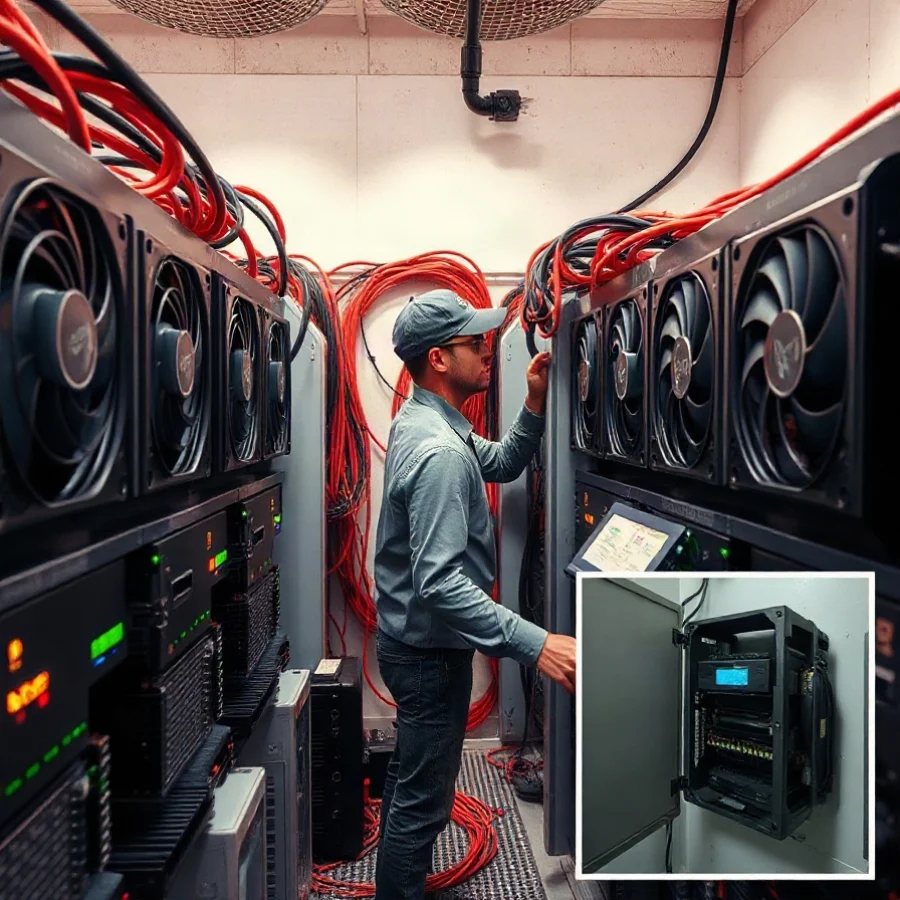
Hardware specifications may list a device’s expected power consumption under particular settings, but the total electrical load can be higher in practice. Mining operations may also use fans, ventilation, networking equipment, power distribution hardware, cooling systems, and other infrastructure.
A more complete calculation uses the facility’s total power draw:
Total power draw = Miner load + Cooling load + Infrastructure load
When cooling or overhead is significant, miners can estimate it with a power usage effectiveness, or PUE, factor:
Adjusted power draw = IT mining load × PUE
For example, a PUE greater than 1 means the facility consumes more total electricity than the mining equipment alone requires. Small home setups may have a different overhead profile from industrial facilities. The correct assumption depends on the physical location, climate, ventilation design, and cooling system.
Compare electricity cost with expected mining revenue
Electricity cost alone does not determine profitability. The operation must compare energy expenses with expected mining revenue and other costs. A simplified daily operating-profit formula is:
Estimated daily operating profit = Mining revenue − Electricity cost − Pool fees − Hosting costs − Other operating expenses
Mining revenue depends on factors that are time-sensitive and uncertain, including the coin’s market price, network difficulty, hashrate, block reward structure, transaction-fee activity, pool payout method, and the miner’s share of network computation. These variables should be entered using current data from reliable primary or industry sources and verified before making operational decisions.
For a broader return calculation, include the hardware purchase and setup expenses:
Estimated net result over a period = Total mining revenue − Total operating costs − Hardware and setup costs
This distinction matters because a machine can have positive operating cash flow while still taking a long time to recover its purchase price. Conversely, a machine that appears attractive after ignoring hardware cost may be less compelling when depreciation, repairs, shipping, and installation are included.
How to calculate the electricity break-even rate
The break-even electricity rate estimates the highest energy price an operation can pay before electricity alone consumes the expected mining revenue. The simplified formula is:
Break-even electricity rate = Daily mining revenue available for electricity ÷ Daily energy use in kWh
To make this useful, subtract expenses that must be paid before electricity, such as pool fees or fixed hosting charges, if those costs apply. The result is not a guaranteed threshold because expected mining revenue can change after the calculation is made.
Suppose a hypothetical operation expects $10 per day in mining revenue after pool fees and uses 72 kWh per day. Its simplified break-even electricity rate would be:
$10 ÷ 72 kWh = approximately $0.139 per kWh
At an electricity price above that illustrative rate, the operation would have a negative daily margin before hardware costs and other expenses. At a lower rate, the operation might have a positive operating margin, but it would not automatically be profitable after accounting for all costs.
Why a small rate change can have a large annual effect
Mining machines operate for many hours, so a difference of a few cents per kilowatt-hour can accumulate over time. The effect can be estimated with this formula:
Annual impact of a rate change = Daily kWh × Rate difference × Operating days per year
Using the hypothetical 72 kWh-per-day machine, a $0.02 increase in the electricity rate would add $1.44 per operating day. Over a full year of continuous operation, the difference would be about $525.60. This example excludes taxes, demand charges, downtime, and changes in power consumption.
The same calculation works in the opposite direction. A lower rate may improve the operating margin, but cheaper electricity does not remove other risks. Mining revenue can decline, hardware can fail, network conditions can change, and an operation may face limits on available power or cooling capacity.
Demand charges and time-of-use pricing
Some commercial electricity plans include demand charges based on the highest power draw during a billing period. In that case, multiplying total kilowatt-hours by an energy rate may understate the actual bill. A more complete estimate may include:
Total electricity bill = Energy charges + Demand charges + Delivery charges + Taxes and other applicable fees
Time-of-use pricing can also change the economics. If the rate varies by hour, calculate consumption separately for each pricing period:
Total energy cost = Sum of hourly kWh use × The rate for each hour
An operator may choose to reduce or pause mining during expensive hours, but that decision has tradeoffs. Reduced operating time also reduces potential mining revenue, and repeatedly shutting down equipment may affect maintenance practices or operational efficiency. Verify the current terms of the electricity contract or hosting agreement before relying on a rate assumption.
Factors that can overwhelm electricity savings
Network difficulty and competition
Mining difficulty and total network hashrate can change the expected coin output from a machine. If competition increases while the machine’s hashrate stays constant, its share of network rewards may decline. A lower electricity rate may help offset this change, but it cannot guarantee a positive result.
Coin price volatility
The value of mined coins can move substantially. A mining operation that appears profitable at one market price may produce a much smaller margin after a price decline. Calculations should use multiple price scenarios rather than a single optimistic assumption. Current prices are time-sensitive and should be checked before use.
Hardware efficiency and downtime
Efficiency is commonly expressed as energy consumed per unit of computational work. More efficient hardware may produce more computation for the same electricity budget, but it can require a larger initial investment. Downtime from maintenance, heat, internet interruptions, repairs, or power limits also reduces actual output.
Pool and hosting costs
Mining pools may charge fees, and hosted operations may charge a bundled rate or additional service costs. Review how the provider defines electricity consumption, whether fees are included, and how downtime is handled. Do not assume that a quoted hosting price includes every cost.
Build a practical mining sensitivity analysis
A sensitivity analysis shows how the result changes when important assumptions move. At minimum, create scenarios for:
- Low, middle, and high electricity rates
- Several coin-price assumptions
- Changes in network difficulty or expected coin output
- Different operating schedules and downtime levels
- Hardware repairs and replacement expenses
- Pool, hosting, cooling, and other operating costs
For each scenario, calculate daily revenue, daily expenses, operating margin, monthly cash flow, and the estimated time to recover hardware costs. A scenario table is more informative than a single profitability figure because it shows which assumptions have the greatest influence on the result.
You can use a crypto profit calculator to organize revenue and cost assumptions, then adjust the electricity rate to compare outcomes. For transaction-related costs or transfers, a crypto fee calculator may help separate network or platform fees from mining expenses.
Questions to verify before mining
Before purchasing hardware or signing a hosting agreement, confirm the following:
- Is the quoted electricity rate all-in, or are delivery, taxes, demand, and service charges separate?
- Is the rate fixed, variable, or subject to time-of-use pricing?
- What power draw and efficiency can the hardware realistically maintain?
- What cooling, ventilation, and electrical upgrades are required?
- How frequently will the machine require maintenance?
- What pool, hosting, withdrawal, and conversion fees apply?
- What happens if the site experiences downtime or power restrictions?
- Are local rules, utility terms, building requirements, and tax obligations relevant to the operation?
Regulatory, utility, and tax treatment can vary by location and may change. Verify those matters with the applicable utility, local authorities, and a qualified professional rather than relying on a general online estimate.
Using electricity data responsibly
Electricity is one of the most measurable inputs in a mining model, but it is not the only one. A realistic estimate combines the machine’s actual power draw with a current, fully loaded electricity cost and a range of revenue assumptions. It should also account for downtime, repairs, infrastructure, fees, and hardware depreciation.
Mining can involve substantial financial and operational risk, and a positive result in one period does not predict future performance. Treat calculator outputs as decision-support information, not personalized investment advice. Recheck market data, network conditions, electricity terms, and local requirements before committing capital or changing an operating strategy.

Comments
0No comments yet. Be the first to share a helpful note or question.
Leave a Comment
Your email address will not be published. Comments are reviewed before appearing on the site.